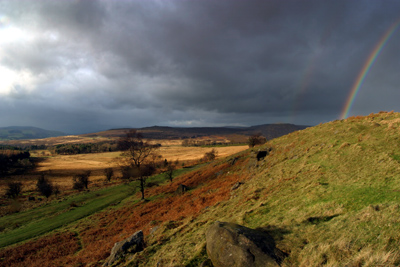
Just spent a few days with some of year 9 on their camp. We stayed at Porlock and spent a day on the hills of Exmoor. It was all good fun (except the steep uphill bits) and the sun shone in abundance. I was given the best compliment ever when someone said that being a Vicar was the last thing they would have guessed I was. No offense to vicars in general but I take it as a good thing to be breaking down stereotypes. There are at least 92 young people in Bridgwater who have now met a vicar and survived the experience. I’m not sure yet where all this effort is going but if nothing else I’m having some good times on the hills.
Black Mountains
Thanks to everyone who helped to makes Easter a great celebration of the resurrection of Jesus.
I’ve seen someone yet again trying to claim that Jesus just passed out on the cross – a popular idea amongst today’s atheists who can’t seem to cope with the historical evidence.
Let’s face it, people die when they are crucified. There is only two recorded incidents of anyone surviving the cross (they were friends of Jospehus a Jewish historian) and they were taken down shortly after crucifixion and given the best medical treatment of the time but neither of them survived for very long. This, of course, says nothing about the spear in Jesus’ side or the fact that we are supposed to believe that someone who had been crucified could get up three days later and start walking around as if nothing happened. And doesn’t it seem something of a coincidence that that the only person who survived and who seemed to have fantastic powers of recovery is Jesus. Also, surely his friends would know the truth and so why did they concoct a story about him rising from the dead? They did not benefit from being a follower of Jesus. It would be a much better idea to return to families and old jobs (which is actually what it seems they did after the crucifixion). By maintaining a story about Jesus rising from the dead (this includes James – Jesus’ own brother) they subjected themselves to hardship, persecution, rejection and finally death.
The truth is Jesus rose from the dead.
In Pilates encounter with Jesus during Holy Week there is the question raised of what is truth? It is an important question and we shouldn’t see Jesus’ reluctance to answer as anything more than an understanding on the part of Jesus that Pilate doesn’t get it. After all Jesus just said everyone on the side of truth listens to me. There is something ironic in those Christians who quote Pilate about truth but fail to quote Jesus, it seems to me.
We should be on the side of truth, no matter where it takes us.
So where does knowledge come from? The Empirical Scientist will claim it is nothing more than what can be physically observed. This fails on all kinds of counts. For instance, it has been pointed out that literary criticism (which is not an empirical science) can tell us that in the book Pride and Prejudice Mr Collins is not the main hero of the story. This is a truth that has nothing to do with physical or mathematical observation. There are other sources of truth than simply physical investigation.
The theologian will also want to add God as a source of truth. If God exists, as a theologian must conclude (if they don’t then they are not theologians but more religious and thought history students) that God is a source of truth. Of course then Christians will want to claim that Jesus Christ is also a source of truth and his incarnation was a deliberate act of God to pass on some truths about God (revelation).
For those who search for truth we should desire to bring in to our thinking all possible sources of truth: Empirical Science, Philosophy, Psychology, Revelation, Mathematics, etc.
Let’s get back to quoting Jesus and not Pilate: “Everyone on the side of truth listens to [Jesus] me.”
On the hills with Haygrove
Another day up on the hills last Saturday with the young people from Haygrove School doing their Duke of Edinburgh Award. It is always an enjoyable day spending time with young people and finding out about what bothers them and what they enjoy. It is also always fastinating seeing those that are good walkers but lack confidence and those who are not so good but think they are.
I’m not sure the Quantocks is a good place to learn navigation though. It is maybe a little too easy.
This walk in the year always reminds me just how little exercise I managed to get over the winter. I think this year with the weekends of rain we have had has been worse than most for not getting exercise.
It got me wondering if there is any time in life when we get the same experience with our spiritual life. I guess times of crisis can make you think that maybe you haven’t been praying enough. But, far better to be praying all the time and then you are ready when the crisis comes – just as it is better to exercise your body regularly so you are ready when you need to exert yourself.
Jesus Course Update

Just completed a redesign of the Jesus Course web site. It is now more user (and webmaster) friendly.
If you like it why not stick a link on your own web site? There are some images and suggested links on this page …
It’s a complicated question to answer and one without a definitive answer. There is always the general church stuff, of course: meetings, worship, bible studies, pastoral work, etc. Then there is the stuff that no one ever sees like the prayer and study, vital but hard to quantify.
What else? Well, I believe that ministry should be done outside the church as well. Time spent with those who have no faith but maybe some questions. What about those who may never respond? Is time spent with them worthwhile? Is it still part of being a minister? I say yes. A minister is uniquely placed to be the church in our communities, not to get bums on pews but to take God’s kingdom outside the confines of the church. Of course this is a role that every Christian should fulfil in some way, and yet there is something very vital about a churches chosen and appointed representative just being out with people.
I wonder how many people get this?
Do you ever struggle with doubt?
It seems that it is a common problem for everyone. The Philosopher doubts their philosophy, the Atheist doubts their atheism, the Agnostic doubts their agnosticsm, the Christian doubts their faith. Not necessarily all the time but enough to make it a problem.
The problem with doubt is that it makes you feel bad. Not having a firm foundation to things you believe can be very disturbing. Sometimes it even leads to psychological problems including anxiety and anger. People who doubt can easily become angry with those who don’t (although those who don’t doubt sometimes do – if you see what I mean). Doubt has caused misery in many peoples lives. Some give up on Christianity because they think it will be an end to their doubts only to discover that there are as many doubts for the atheist as their are the theist.
The good thing about doubt is that it forces you to ask questions. Questions are important to deepening understanding and faith.
The standard condition for the Christian should be one of faith and not of doubt. I sometimes get the impression that some Christians think that being a doubter is the best way but Jesus always encouraged people to have faith (and of course faith is the opposite of doubt). It is very important to embrace your doubts and not just try to ignore them. If you ignore them they do damage, if you face them you can do things to help yourself.
We will explore this in more detail on another occasion but to end this part let me give you a way to start managing your doubts.
Pray, be thankful to God, and meditate on God.
It is a simple thing but so important to help with doubts. Talk to God about them. Try to develop an attitude of thankfulness for the things you do have and can be sure of. Give yourself some time to think about God.

Atheist for a year
I came across the story of a man (who says he is a Christian) who is taking on the challenge of being an Atheist for a year. This, of course, follows on from lots of other people who have tried various ways of living for a year.
It seems to me that this is a crazy idea. If you believe something is true – which as a Christian presumably he must – how can you then say that for a year you will not believe it? Isn’t this being dishonest with yourself? What about his relationship with God? Isn’t it a little arrogant to say to Almighty God that you are not going to believe or worship for a year for the sake of your experiment?
He seems to be a little upset that all of the Christian organisations he is currently working for are raising questions and some of them giving him the sack. He works in a pastoral role as well as a research and teaching role (as I understand things – I might be wrong). If someone worked promoting atheism and then became a Christian I would expect them to resign – not complain if they get the sack.
If anyone else if seriously considering an experiment of becoming an atheist for a while I would counsell against it – there are some lines you should not cross.
But that’s just my opinion.